I'm going to take this opportunity to brag a bit, so bear with me. My grandfather, Hal Shelton, was a cartographer and artist. He graduated from Pomona and then worked for the US Geological Survey creating maps for WWII and also later mapped many different parts of the world as well as places like ski resorts (many of those images that you see at the slopes that show the mountain with the various ski routes were done by him!). He was one of the first people to use natural colors in maps, meaning he created maps that actually looked like the land itself, rather than using different colors to show the states or having a legend that said "mountain ranges: brown" etc. Today, we take this for granted because the maps we see are from satellite images that obviously photograph the natural colors, but in his day, it was rather dramatic to shift to doing this. I found
this awesome article, which none of you should read because it probably won't be awesome to you, about my grandpa's work that has gotten me thinking about cartography today. My grandfather spent hours flying in planes and taking pictures of and sketching the ground so that the map could accurately depict the changing colors from forest land to desert to mountain, etc. The work is both scientific and artistic. Now, though, we have incredibly detailed and accurate photographs from satellites that are easier to use and even more scientific. Is cartography dead? I think a very interesting thesis (not necessarily an AMST one, but possibly!) could look at this issue and the ways people still use maps, how people conceive of the geography around them, what opportunities there are in the field of map making, etc.
 |
| Here's a picture of a picture of my grandfather in his studio working on a shaded relief map. |
 |
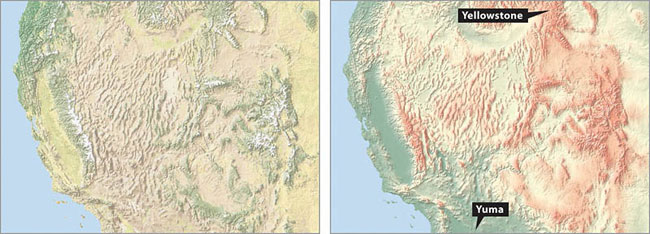
The photo on the right is how they used to make maps, by using dramatic colors that clearly show different topological things. The left is one by my grandpa, which shows more accurately what the land looks like from above.
|


No comments:
Post a Comment